Keypoints
– Historical Housing Realities: Glendora’s classic mid-century ranch homes and historic foothill bungalows feature incredible character, but their underlying electrical wiring was built for an era with fractionally lower power demands.
– Early Warning Systems: Physical signs like scorched outlets, persistent wall buzzing, unprovoked flickering lights, and warm switch plates are active indicators of electrical resistance and hidden fire hazards.
– Specific Legacy Hazards: Pre-1950s knob-and-tube setups lack ground pathways, while 1960s and 1970s aluminum branch wiring carries elevated thermal expansion risks that require targeted professional remediation.
– Modern Grounding Protection: Two-prong outlets leave modern microprocessors and family members vulnerable to voltage surges and shock risks; simple adapter plugs do not create a safe ground pathway.
– Proactive Safety Audits: Comprehensive electrical inspections isolate specific failing circuits, allowing targeted repairs or partial rewiring without unnecessary wall destruction.
Introduction
Glendora has a personality all its own. Drive down the tree-lined streets near the foothills or through the quiet neighborhoods built during the mid-century boom, and you will see why people fall in love with living here. From 1920s craftsman bungalows to 1960s custom ranches, these homes have character you just cannot buy in brand-new subdivisions.
There is a catch, though. Tucked away behind that vintage plaster and original molding is an electrical framework that has been working continuously for decades.
Back when these houses were put on the grid, life looked completely different. A typical living room might have had a floor lamp, a vacuum cleaner, and a small tube radio running on the same circuit. Fast forward to today, and that very same wiring is expected to carry the load for central air conditioning during 100-degree August afternoons, high-draw kitchen gear, home office setups, big-screen electronics, and electric vehicle chargers in the garage.
At Pro Electric Services Inc., we lead with a simple principle: teach first, sell second. Having older wiring does not automatically mean you need to tear down your walls and start over. But it does mean you ought to know what type of wiring runs through your house, how to spot early warning signs of heat buildup, and what smart, non-invasive safety solutions look like when dealing with outdated electrical wiring.
Why Are Older Glendora Homes Particularly Vulnerable to Wiring Hazards?
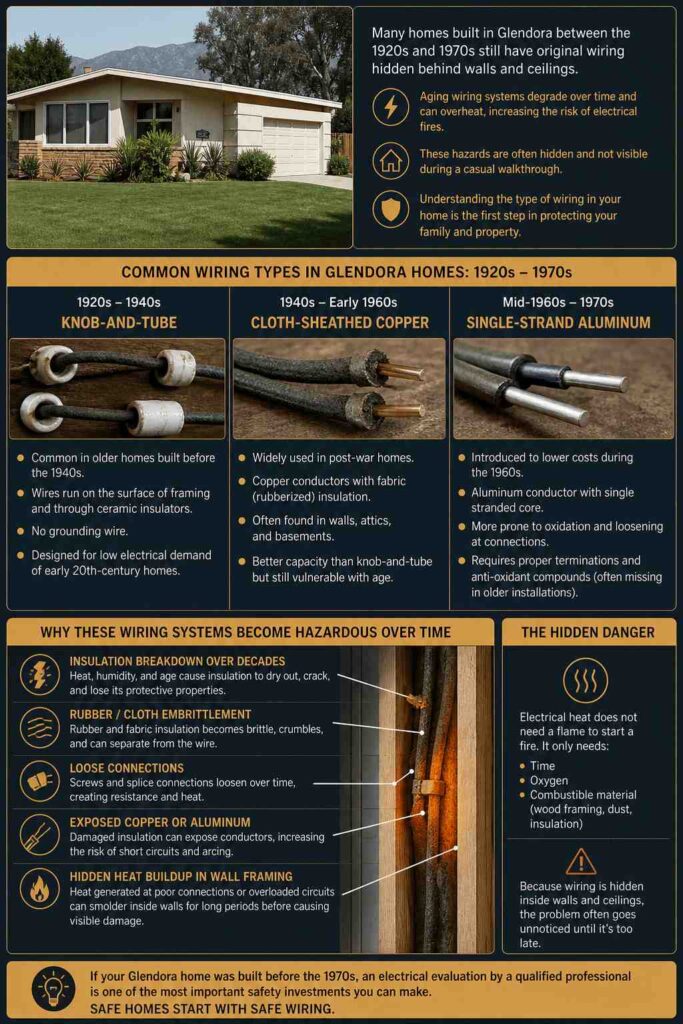
Building materials and safety codes have come a long way over the last several decades. When we open up walls in established Glendora neighborhoods, we usually run into one of three distinct types of vintage wiring: knob-and-tube setups common before 1950, cloth-sheathed copper cables standard throughout the 1950s and early 1960s, and single-strand aluminum wiring installed heavily from the mid-1960s through the late 1970s.
As copper and aluminum lines age, two main problems crop up: the insulation breaks down, and the physical connections work themselves loose. Decades of electricity flowing through these wires generate low-level ambient heat. Over time, that continuous warmth bakes the old rubber or cloth wrapping until it turns brittle, flakes off, and leaves bare metal exposed inside your wall framing. Once that protective cover degrades, your odds of short circuits, hidden electrical arcing, and localized fires jump dramatically.
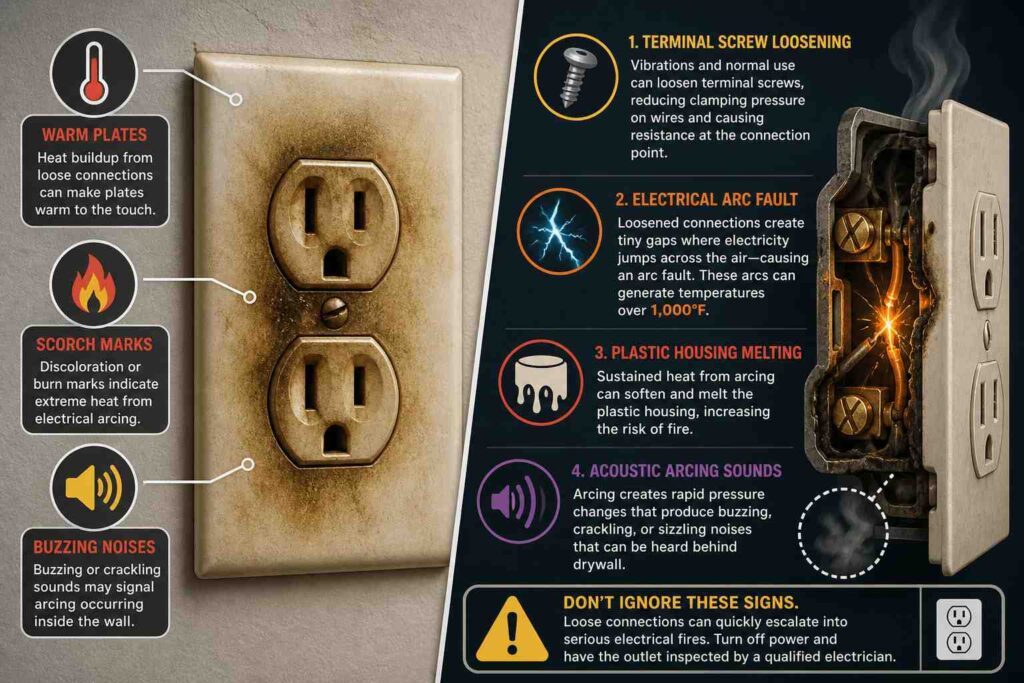
Sign 1: Why Are Your Outlets Warm, Discolored, or Making Buzzing Sounds?
If you put your hand against an outlet plate and feel noticeable warmth, or if you catch a subtle brownish scorch mark around the plug slots, your electrical setup is running hot. Under normal conditions, copper lets power slide through with almost zero friction. But when terminal screws back out over time or copper ends corrode, electricity has to force its way across microscopic gaps to complete its circuit.
Electricians call that leaping action an arc fault. Arcing produces intense bursts of localized heat that can easily top 1,000 degrees Fahrenheit, melting the plastic housing inside the wall long before a standard breaker ever registers a problem and trips. If you hear a soft buzzing, crackling, or popping sound near a socket when you plug in a vacuum or a space heater, you are listening to active electrical arcing happening right behind the drywall.
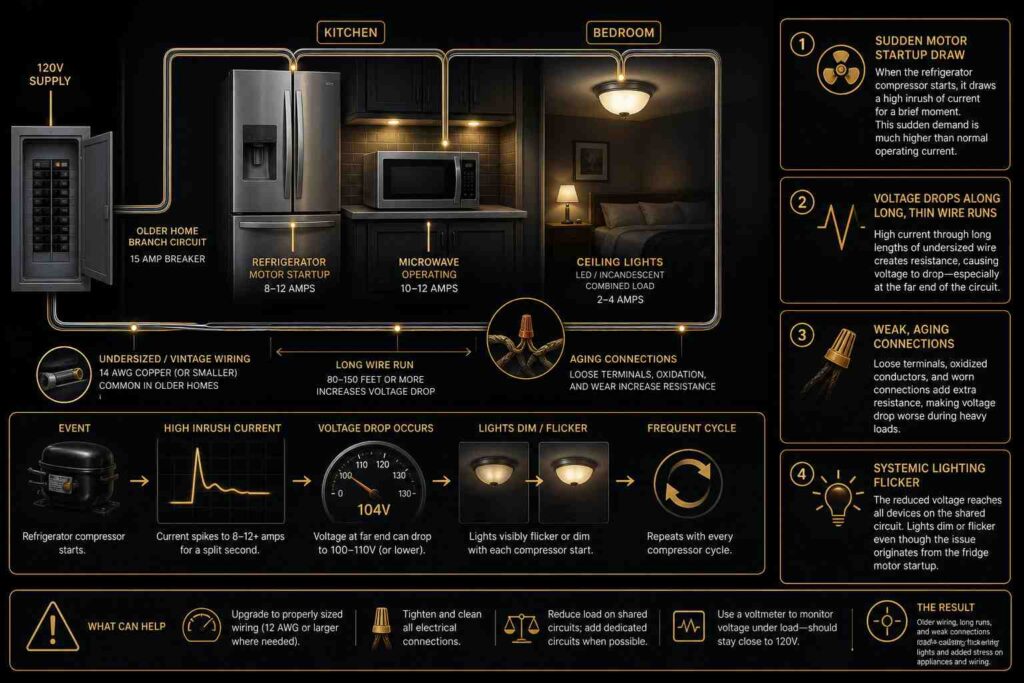
Sign 2: What Does It Mean When Your Lights Dim or Flicker Unprovoked?
It is easy to blame a flickering overhead light on a cheap bulb or a loose socket. But if lights across an entire bedroom or hallway drop in brightness the moment your refrigerator cycles on or the microwave starts running, you are dealing with a systemic voltage drop along your branch lines.
In older construction, electricians frequently wired long chains of outlets and light fixtures together on single, thin-gauge branch circuits. Heavy appliances draw a sudden, heavy burst of current when their motors start up. If those supply lines are undersized or have weak, aging connections along the run, line voltage drops instantly across the whole circuit, causing your lights to dim until the power levels out.
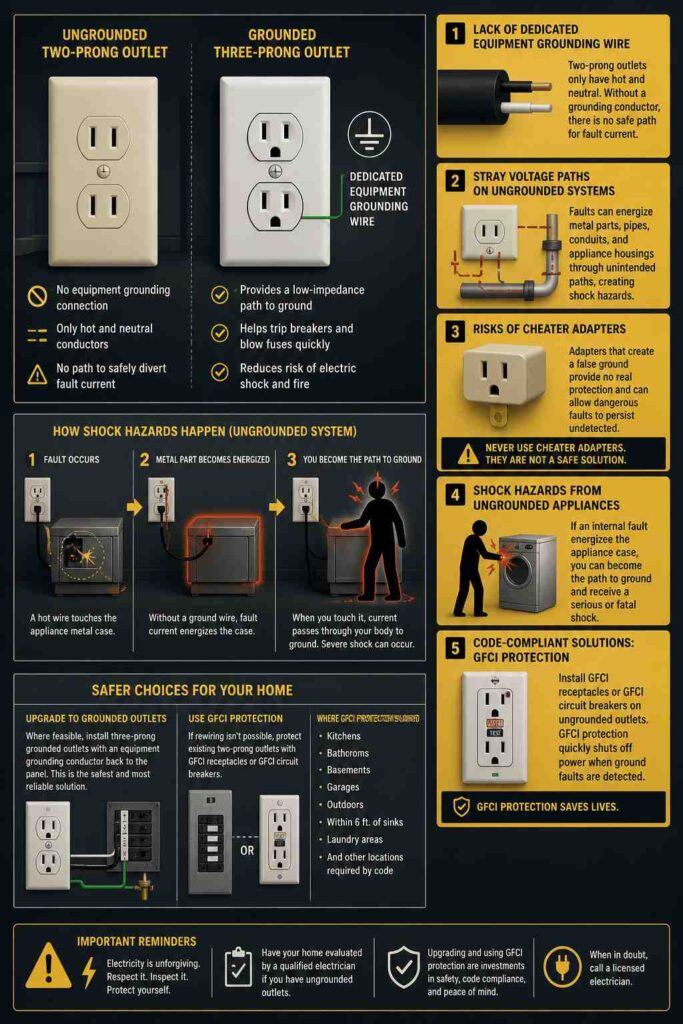
Sign 3: Why Do You Have Two-Prong Outlets and Frequent Shocks?
Seeing two-prong outlets in a room tells you one thing right away: your electrical system lacks a dedicated equipment grounding wire. On a modern three-prong receptacle, that bottom rounded hole connects to a bare copper wire that dumps unexpected electrical surges safely down into a grounding rod driven deep into the dirt outside your home.
Without that ground line, any stray voltage caused by an internal short inside a plugged-in appliance, like a metal-cased toaster, a power tool, or an old mixer, searches for the easiest path to the earth. Far too often, the person holding the device becomes that path, resulting in anything from a sharp static-like shock to a dangerous electrocution hazard. Using those little grey two-prong to three-prong adapter plugs lets you force a modern plug into the wall, but make no mistake: it does not create a safe ground path.
Sign 4: What Are the Specific Risks of Knob-and-Tube and Aluminum Wiring?
Knowing which generation of wiring runs through your home makes it much easier to decide on the right maintenance steps:
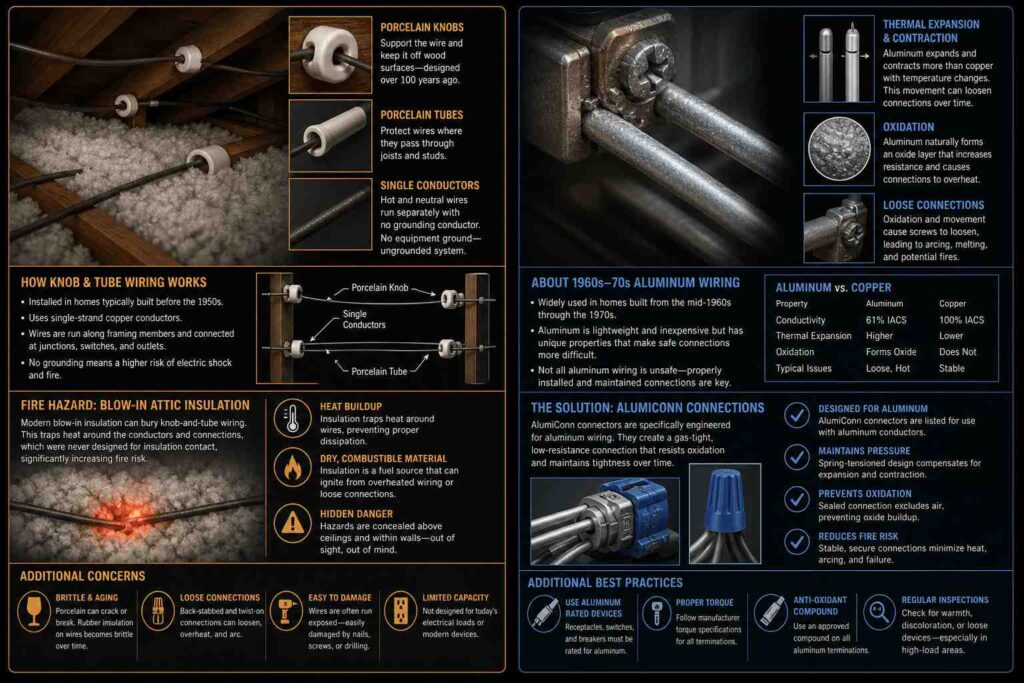
Knob-and-Tube Wiring: Built with single copper conductors run through porcelain knobs and ceramic wall tubes, this pre-1950s system lacks a grounding conductor entirely. It was designed to stay cool by shedding heat into the open air inside wall cavities and attics. When modern homeowners blow loose insulation over old knob-and-tube runs in the attic, that trapped heat bakes the old cloth wrapping, creating a major fire risk.
Aluminum Wiring: Soaring copper prices in the mid-1960s to mid-1970s led homebuilders to switch to single-strand aluminum branch lines. The catch is that aluminum expands and contracts significantly more than copper whenever power passes through it. Decades of that creeping movement, combined with aluminum’s tendency to form a resistive oxide layer when exposed to air, causes connections at switch terminals to loosen up, creating dangerous hot spots over time.
Sign 5: Why Do Burning Smells or Burning Plastic Odors Keep Appearing Near Outlets?
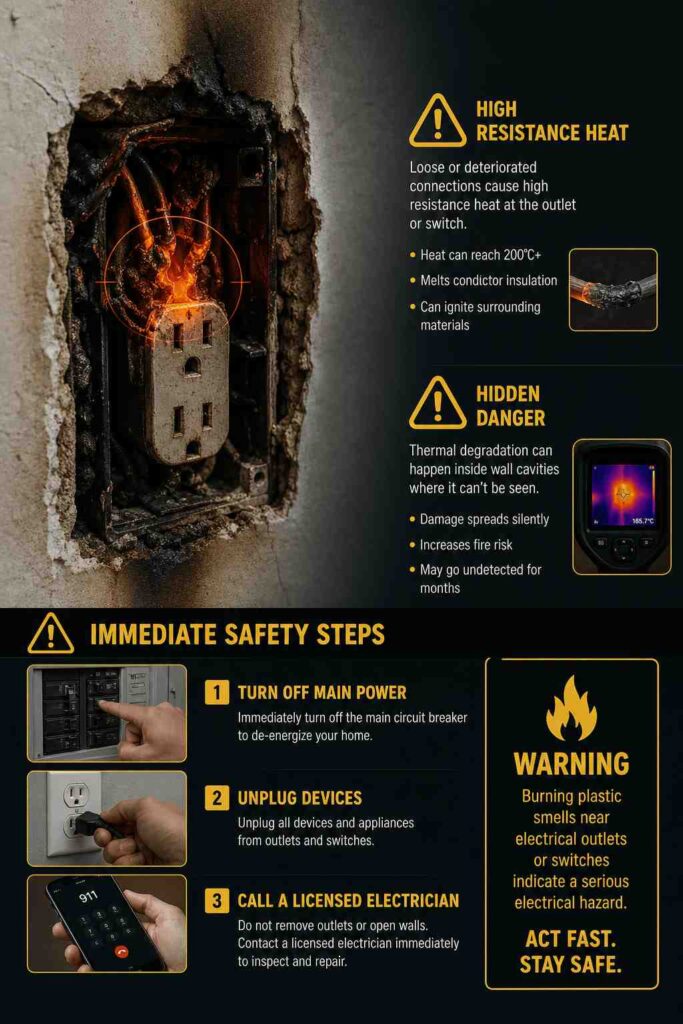
A sudden smell that reminds you of melting plastic, hot vinyl, or a sharp chemical odor is one of the clearest warning signs your electrical system can give you. That smell means high electrical resistance is generating enough heat to melt the synthetic insulation wrapping your conductors or soften the plastic junction box mounted in your wall.
Because this thermal damage happens out of sight inside wall cavities, you might not see any visible smoke or flame right away. If you ever notice a persistent hot plastic smell near a wall plate or appliance switch, head straight to your main breaker box, flip the main power switch off, unplug your devices, and get a professional electrician out immediately.
Real Scenarios: How Honest Diagnostics Protect Older Homes
These warning signs are not just theoretical hazards. They show up in real Glendora homes every single week, requiring careful, honest evaluation rather than blanket fear tactics.
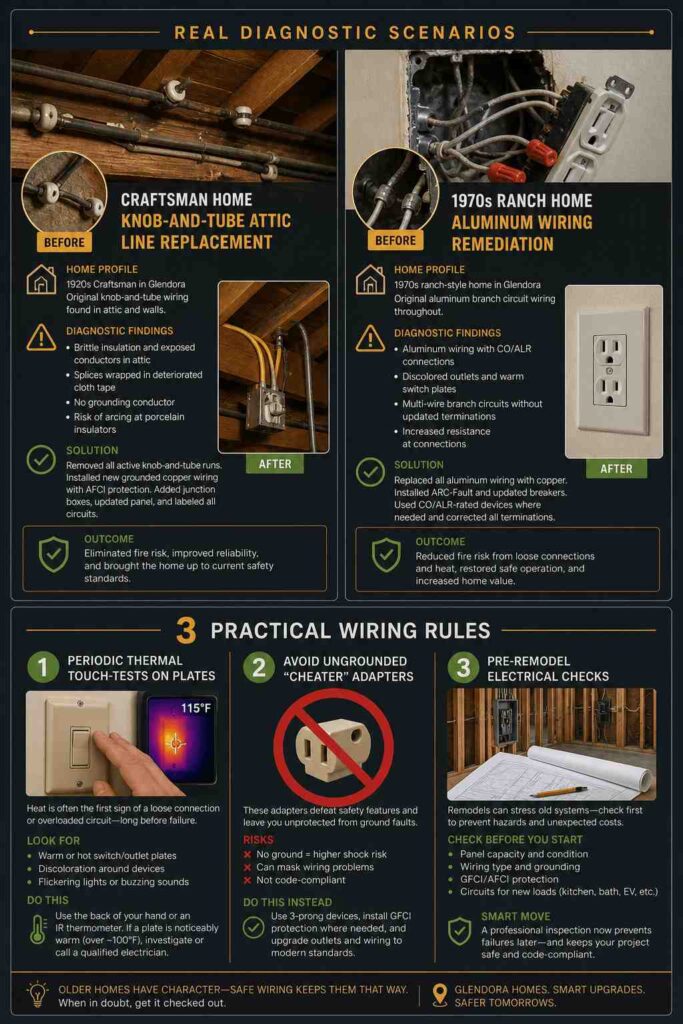
Scenario A: The Historic Foothill Craftsman
A homeowner in a beautifully kept 1930s bungalow near Glendora’s northern foothills noticed her bedroom lights flickered every time the bathroom space heater kicked on. Another contractor told her the entire house had to be gutted and rewired from scratch for $25,000.
What Diagnostics Revealed: Our detailed inspection showed that while original knob-and-tube wiring was still present in the unconditioned attic, the major branch lines for the kitchen and living area had already been updated years ago. The active hazard was restricted to a single compromised attic line where recent blow-in insulation had buried exposed vintage wires.
The Solution: Instead of tearing out walls across the entire house, our team isolated and replaced only that single attic circuit, feeding it from a code-compliant sub-panel while leaving the rest of her intact interior walls completely untouched.
Scenario B: The 1970s Ranch Home with Warm Switches
A family living in a 1972 ranch home noticed their hallway light switches felt surprisingly warm whenever the living room lamps and television were running in the evening.
What Diagnostics Revealed: The home was built with single-strand aluminum branch lines. Four decades of thermal expansion had loosened the original twist-on wire nuts behind the wall plates, creating high-resistance hot spots.
The Solution: Rather than opening up the drywall to run entirely new copper cables, we performed an approved aluminum remediation process. By installing specialized AlumiConn torque-rated connectors and an antioxidant compound at every switch and outlet box, we stabilized the aluminum-to-copper connections safely and saved the family thousands of dollars.
3 Practical Rules for Managing Older Home Wiring
- Touch Your Switch Plates Periodically: Get into the habit of touching your light switches and outlet plates after high-draw appliances have been running for 15 minutes or so. If a cover feels noticeably warm or looks discolored, it is time for a professional safety check from a licensed local electrician in Glendora, CA.
- Ditch the Ungrounded Adapters: Stop relying on those two-prong cheater plugs for three-prong devices. If you need grounded power in a room, have a licensed electrician evaluate whether adding a grounded line or installing code-approved GFCI protection is the right step.
- Get an Inspection Before Remodeling: If you are planning a kitchen refresh, a bathroom remodel, or adding insulation to an older Glendora home, get the electrical infrastructure checked out before any drywall comes down. Catching legacy wiring issues early prevents costly surprise change orders in the middle of your project.
Conclusion
Living in an older Glendora home gives you architectural character you simply cannot replicate in modern construction, but those vintage electrical systems require proper care and respect. Noticing warning signs like dimming overhead lights, warm switch plates, or legacy aluminum and knob-and-tube lines allows you to handle potential hazards before they escalate into emergencies.
At Pro Electric Services Inc., we build our business on straightforward communication, clean craftsmanship, and solid safety education. We specialize in evaluating historic and mid-century Glendora properties, finding practical, targeted solutions that keep your home safe without unspooling your budget.
Want to know for sure what is going on behind your walls? Contact Pro Electric Services Inc. today to book a clear, thorough home electrical safety inspection in Glendora.
Frequently Asked Questions
Rewiring costs depend on your home square footage, wall materials, and accessibility. Most single-family home rewiring projects land between $8,000 and $20,000+, and we always provide clear, itemized estimates after a detailed safety audit.
Yes, current building codes allow you to install a GFCI outlet on an ungrounded system to protect people from shock risks downstream. However, while a GFCI makes that outlet safer for human touch, it still does not supply a true equipment ground wire for sensitive microprocessors in modern electronics.
Many major insurance carriers in California will not issue or renew policies for homes with active knob-and-tube wiring because of the increased fire risks involved. Replacing affected attic runs or providing a certified electrical inspection report is often necessary to keep standard home coverage in place.
Experienced electricians use long flexible drill bits, fish tapes, and small cutouts hidden inside closets or behind baseboards to thread new cables through floor joists and wall studs. This careful approach keeps cosmetic damage down to a minimum and saves you significant drywall repair costs.
Partial rewiring focuses purely on fixing specific high-risk zones, like swapping out attic knob-and-tube or stabilizing aluminum wiring in heavy-use kitchens, while leaving functional modern circuits alone. Full-house rewiring removes every piece of legacy wire in the building, replacing every line, socket, switch, and panel connection from top to bottom.
Having original aluminum wiring in your house is not illegal, but current building codes no longer permit installing it on standard 15-amp and 20-amp branch circuits. If your home has existing aluminum lines, an electrician can remediate them safely using code-approved connectors without tearing out every wire in the house.
A full rewiring project on a typical three-bedroom home usually takes between 5 and 10 workdays. Power is turned off in specific work zones while technicians are on site, but we make sure essential power is restored to your living areas before wrapping up each afternoon.
Yes, degraded wiring with high electrical resistance turns electrical energy into wasted heat as current moves along deteriorating lines. Loose neutral connections also make your major appliances work harder to run, which pulls more total kilowatt-hours over the course of a month.
A tiny, fast blue spark when plugging in a device that is already turned on is usually just normal electrical arc draw as contacts touch. But if you see large yellow or white sparks, hear a loud pop, or spot black burn marks on the faceplate, you are looking at dangerous arcing that needs immediate inspection.
Yes, modern California Electrical Codes require AFCI breakers on most new or extended residential branch circuits. AFCI protection detects dangerous electrical micro-arcing inside wall cavities and cuts power long before standard breakers react, giving older homes an essential layer of fire prevention.